from Libya Herald..
By Valerie Stocker
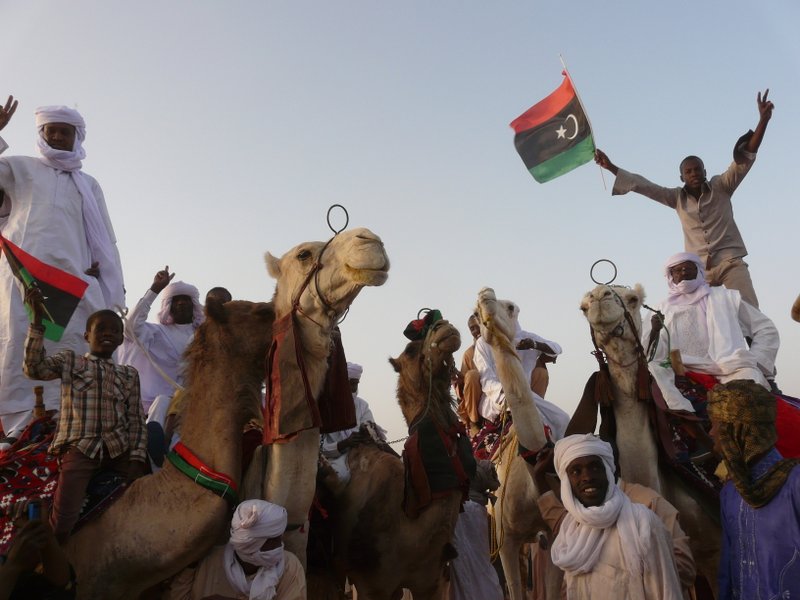
(Photo: Valerie Stocker)
Murzuk, 8 April 2013:
Deadly migrant trails, cross-border smuggling, bloody tribal clashes, extremist militants and weapons proliferation – the news that usually reaches us from the south of Libya draws a gloomy picture of this remote and inhospitable part of the world.
Less known is that the Libyan Sahara is also home to diverse cultures and traditions that neither difficulties nor oppression nor war have been able to extinguish and that are now experiencing revival in post-revolutionary Libya.
A glimpse of the cultural riches could be seen last weekend in the town of Murzuk, almost 800 kilometres south of Tripoli, where people from a vast desert area larger than most European countries congregated for the first-ever official Tebu festival in Libya.
Organised by a local civil society organisation called the Sons of the Desert, the “First Zaala’ (Tebu for “Fezzan”) Festival for Tebu Heritage and Culture” featured displays of popular art and traditions handed down from one generation to another. Intended as both an occasion for different Tebu tribes to celebrate their common heritage as well as a means to reach out to the world, the festival drew from a wide area including visitors from northern Libya and a number of government officials.
Hardly mentioned prior to the revolution, the Tebu have since gained some notoriety, mainly due a series of clashes with their Arab neighbours in Kufra and Sebha with whom they compete for land and power. But what is being perceived by many others as a sudden grasp for power and a threat to the existing social order is in fact the long-withheld assertion of what the Tebu see as their legitimate role within the state.
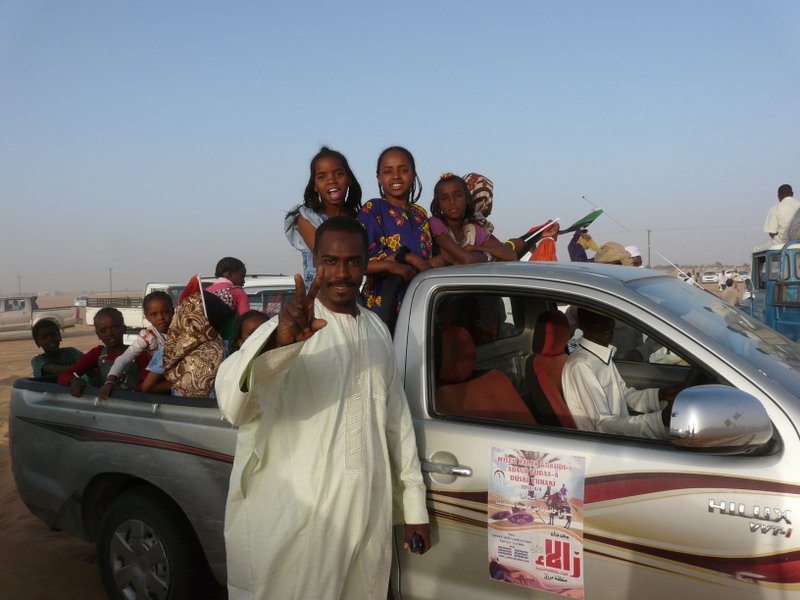
Families coming to the Tebu Festival (Photo: Valerie Stocker)
“Aren’t we all descendants of Adam and Eve?”
A conference on Tebu culture and minority rights marked the start of the three-day festival on Thursday morning. Lined up in front of the community hall, Tebu sheikhs and Local Council members ceremoniously welcomed their guests of honour, including the General National Congress’ Second Deputy President, Saleh Al-Makhzoum, who is from Wadi Eshatti, and Musa Harim, Vice-Minister of Culture and Civil Society, as well as several other Congress members.
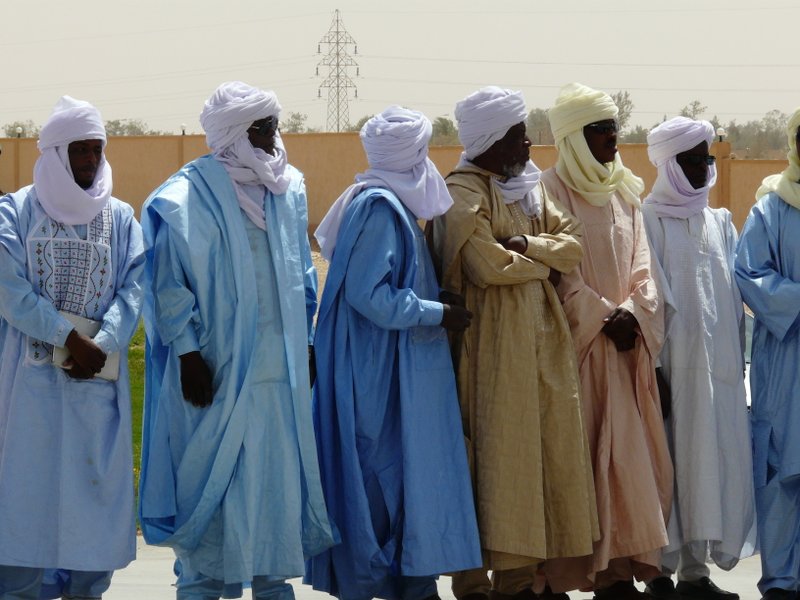
Tebu dignitaries welcoming their guests (Photo: Valerie Stocker)
Crammed into a far too small conference hall, those who had managed to push their way past the increasingly distressed guards – officials, local residents, civil society activists and media representatives – stood for the national anthem, which was played both in Arabic and Tedaga, the language spoken by the Libyan and Chadian Tebu. Speakers of different backgrounds and representatives from other parts of Libya then shared their view on the history, identity and aspirations for the Tebu people, whose homeland comprises parts of Libya, Chad and Niger. Numbering around 400,000, this group of originally semi-nomadic herdsmen is divided into two sub-groups: the Teda in the North and the far more numerous Daza in the South. According to official figures, only 12,000 to 15,000 live in Libya although the Tebu themselves claim that there are in fact many more legally stateless people on the Libyan soil who are not being taken into account by these estimates. In the presentations, special emphasis was put on their struggle for recognition as indigenous ethnic group or “original people” (sha‘ab asli) with legitimate claims to the land they settled on when they began giving up their nomadic lifestyle around the mid-20th century.
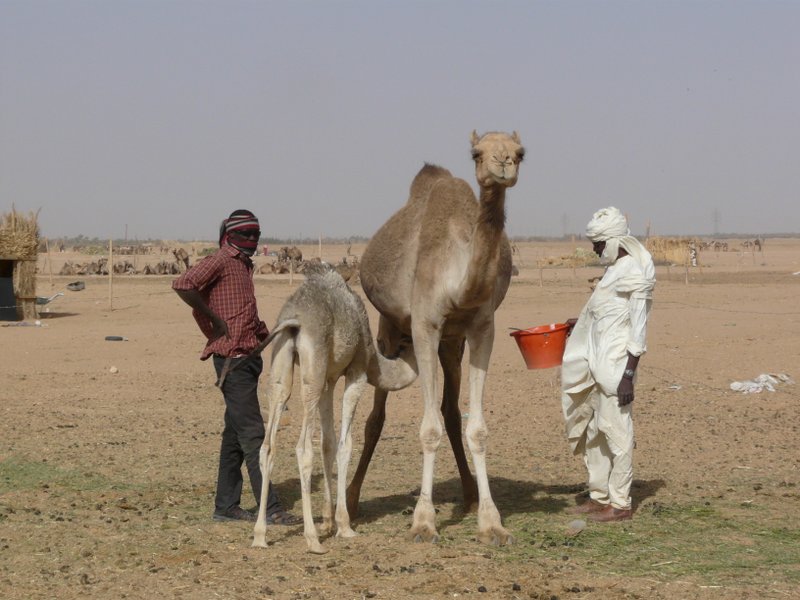
Semi-nomad herders at Fungul, Libya’s main camel market (Photo: Valerie Stocker)
Under the Qaddafi regime, the Tebu were subject various discriminatory policies, including forced displacement, denial of citizenship and socio-economic and political exclusion, in addition to being viewed as alien intruders by fellow countrymen. In fact there was rarely any mention of their existence as social group. This knowledge gap was mainly the result of deliberate omission practiced by the regime for political reasons. While Qaddafi openly promoted African brotherhood and integration, he systematically marginalised an ethnic minority whose allegiance he could not win.
Every Tebu seems to have a story to tell about lived discrimination. “Look here”, said a man at the festival pulling out the file tucked under his arm. “On all documents it says ‘Nationality: not Arab’! As if one had to be Arab to qualify as a good citizen. No matter how good your qualifications, these two words made it much harder for us to achieve anything.”
Access to higher educational institutions and skilled jobs was very limited, and even minor administrative procedures could make life complicated for those without proper IDs.
All personal data in Libya is based on the kutayyib (family book), in which Tebu children are registered as born in the Aouzou strip, current-day Chad. As a result of the protracted war between the two countries and the 1994 ruling by the International Court of Justice that forced Qaddafi to return the conquered strip of land, he declared that the Tebu were in fact Chadians and had to register there, although he had once offered them citizenship in return for political backing. The situation worsened in towards the end of the first decade of the percent century when the regime withdrew citizenship from a part of the community, issued decrees that barred them from accessing basic public services, and later demolished Tebu homes in Kufra, expelling residents to Chad.
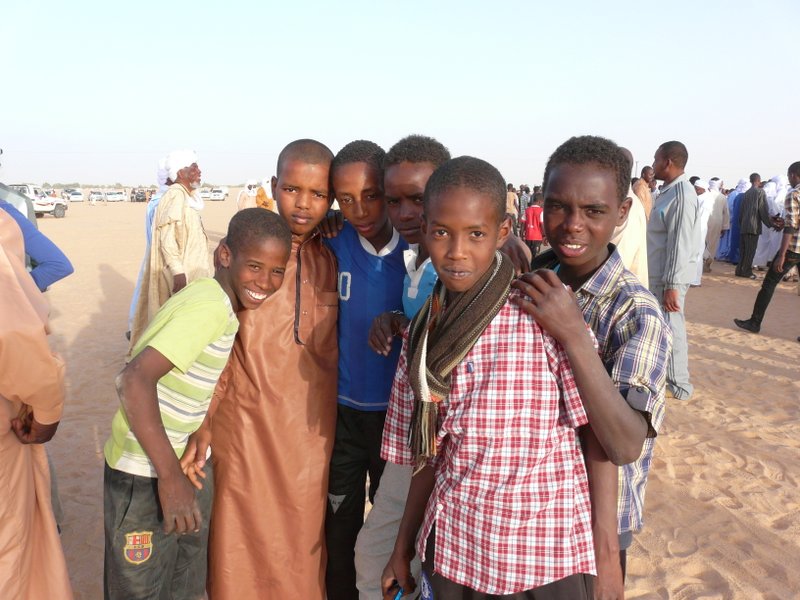
Young Tebu boys enjoying the festival (Photo: Valerie Stocker)
The non-Tebu speakers at Thursday’s conference struck a conciliatory tone, pointing out that shared experiences and Islam unite all people of Libya. Saleh Al-Makhzoum congratulated the people of Murzuk and called the festival a contribution to the country’s diversity. “We are all flowers of a single tree”, a GNC member from the Jebel Akhdar declared emphatically. “Don’t we all descend from Adam and Eve?”, another speaker asked.
“We are second-class citizens”
But the reality outside conference halls and popular celebrations showed a different picture. “At the hospital, for instance, they don’t treat us as equals”, complained Hawa, a young mother. “As soon as they hear or see ‘black southerner’, they send you away or let you wait longer than everyone else. For Arab Libyans, we are second-class citizens.”
Unlike many others, she did however get the chance to complete her higher education in the capital. The problem was finding a job afterwards: “Until now, we were also barred from working for the civil service and therefore denied the benefits that many of our Arab neighbours received from the state”.
But the socio-economic makeup of Murzuk seems to have shifted since the revolution. Driving through town in his newly imported Korean car, whose seats were still wrapped with plastic foil, Ahmad, a young Tebu, pointed at a row of houses that were mostly unfinished but grand in comparison to the rest of the dwellings. “Arab families,” he said with disdain. “They had everything – good salaries, cars, villas. It wasn’t fair.” Asked whether he thought there were now less Arab inhabitants than before he replied: “On the contrary! They have more children than we do.” While life may have improved for previously underprivileged strands of society, mutual resentment and misperceptions persist and will have to be tackled by community leaders on both sides to keep them from drifting further apart.
As was outlined by lawyers and historians attending the event, the Tebu want their status as indigenous minority to be enshrined in the new constitution to ensure that their civil and cultural rights will be respected in future. One of the demands is a bilingual region, which implies being allowed to teach Tedaga to Tebu children and use it for road signs or public adverts. Orally transmitted over centuries and widely spoken, even among young people, the dialect of the northern Tebu has only recently been written in Latin script. The two Tebu newspapers founded since 2011 are still printed in Arabic, however.
The Tebu also want the central government to acknowledge their role as main force of the Fezzan offensive against Qaddafi troops and provide more support to ex-rebels. Locals would like to see new public and private initiatives to develop the Murzuk region, whose population – they claim – does not get any share of the oil wealth. “What we would most like to have right now is a public park for families to take their children out”, says a father from Murzuk.
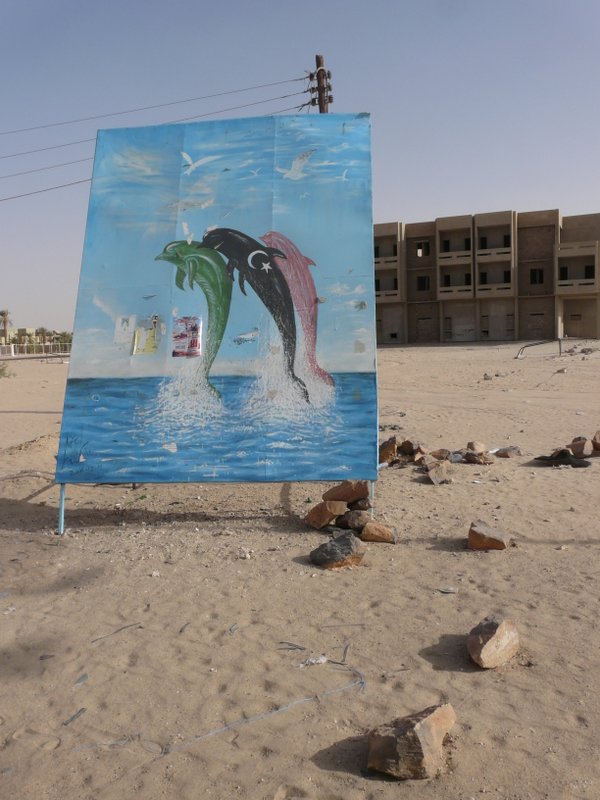
Revolutionary billboard in Murzuk town centre (Photo: Valerie Stocker)
Another important point later raised in conversations is the idea of a direct road to breach the almost 1,000 kilometres of desert between Sebha and Kufra. Other than four-wheel drives, vehicles currently have to go up all the way to the coast in order to drive back south, which makes the trip twice as long. Clearly this is not only of logistical but also of strategic importance for the Tebu, whose population – and armed forces – are concentrated in both areas.
After this rather serious inauguration of the festival, a group of men and boys performed a traditional dance in front of a much larger crowd outside the town citadel, while locals exhibited artefacts and traditional household items. Kidi, Nangara, Russ and Himmi – the four main dances known to all Tebu – were accompanied by rhythmic music distinctly different to other musical styles in Libya.
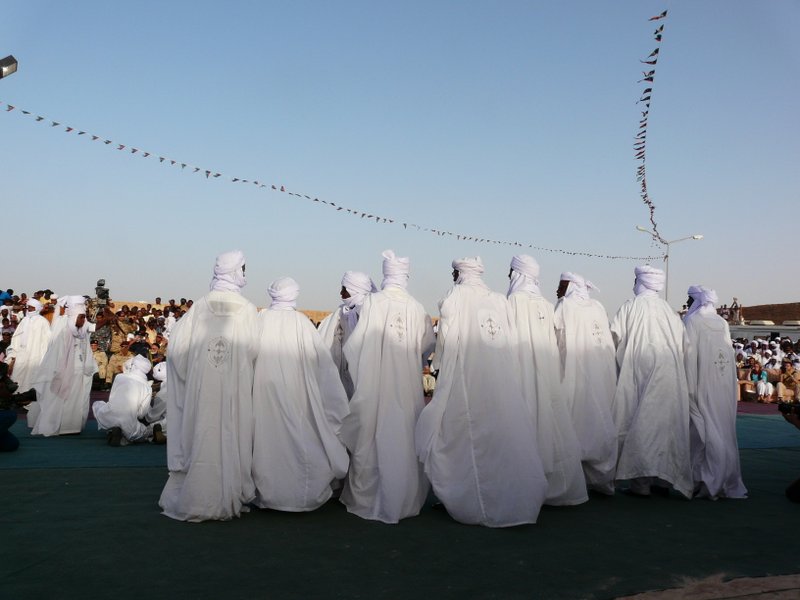
Tebu men dancing (Photo: Valerie Stocker)
In the evening of the second day, all the men gathered in the desert just outside town for what was announced as a camel race but turned out to be more of a folkloric show that eventually degenerated into chaos, when a camera crew on the back of a pickup had the riders follow them at high speed on a narrow road clogged with vehicles. Ostensibly undisturbed by the commotion, the visitors – some of whom had come from as far as France and Belgium – were exhilarated by the display of desert chivalry and the crowd swerved back and forth, forming a close circle around the lavishly adorned camels and their proud riders.
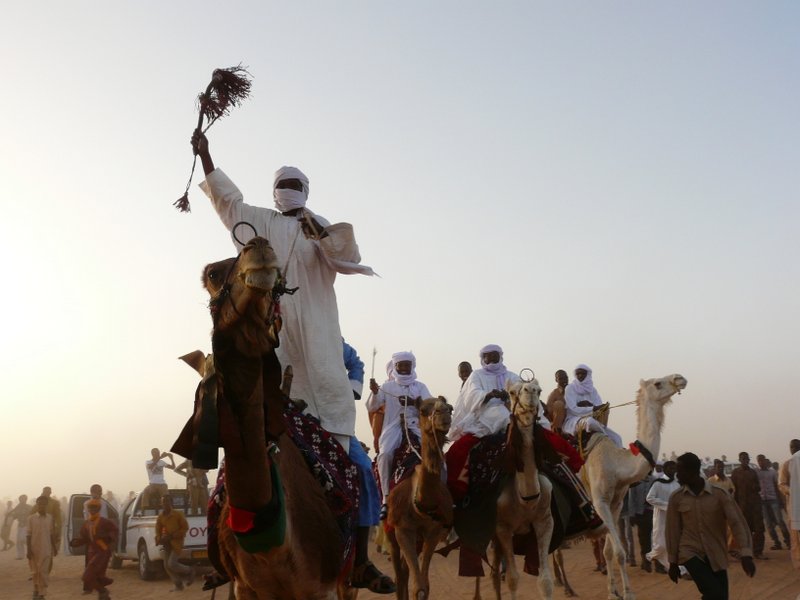
Camel-riders pursued by the excited crowd (Photo: Valerie Stocker)
Disappointment within the community
However, not everyone was happy about the way things had been done. “I am extremely disappointed. We have waited for this day a long time and wanted this to be not just a festival but the best festival”, exclaimed Mohamed, a community activist and project manager who was only called in to help during the final stage of the preparation. “The actual planning only really began two weeks before the set date, but by then it was too late to call it off because the news had already spread across the whole southern region”.
Having seen similar events in other parts of the country, the festival did not appear exceptionally chaotic, but for the unhappy activist there was clearly more at stake than just sharing a fun time. Not many outsiders know about Tebu culture and he was hoping the event could pave the way for increased interaction with the country’s other communities and more understanding for his own people.
Expecting extensive media coverage, the organisers were surprised that not many reporters and television crews turned up for their event. In order to achieve greater visibility, they resorted to the costly services of a media company entitled to re-sell video footage. They also regretted that, with the exception of the Turkish Consul, a UN delegate and a handful of NGO members, no foreign representatives made it down to their town, presumably due to security concerns.
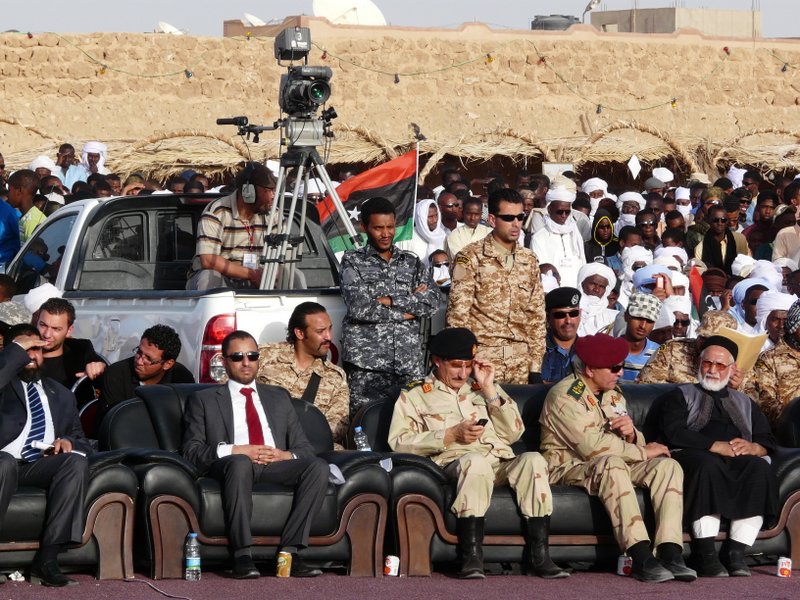
Guests of honour watching the dances (Photo: Valerie Stocker)
“There will be no security and peace in south Libya without the Sons of the desert”
Security is indeed a major problem in Libya’s south-west bordering Niger and Algeria, and although the Tebu claim they have full control over most of this vast desert area, the potential risk of such exposure can hardly be assessed by outsiders. Last January, the GNC declared the entire territory south of Sebha and Kufra a military zone and all southern borders temporarily closed. Unsurprisingly, this announcement has so far had little impact on the ground, as the army has nowhere near the manpower and equipment required to patrol several thousand kilometres of mostly unmarked borderland. Now under the umbrella of the Ministry of Defence and the Chief of Staff, it is still mostly Tebu brigades that are manning the checkpoints and securing some of the oilfields in the Murzuk Basin,as well as north of Kufra. The army has recently been sending reinforcement from other parts of Libya, mostly Cyrenaica.
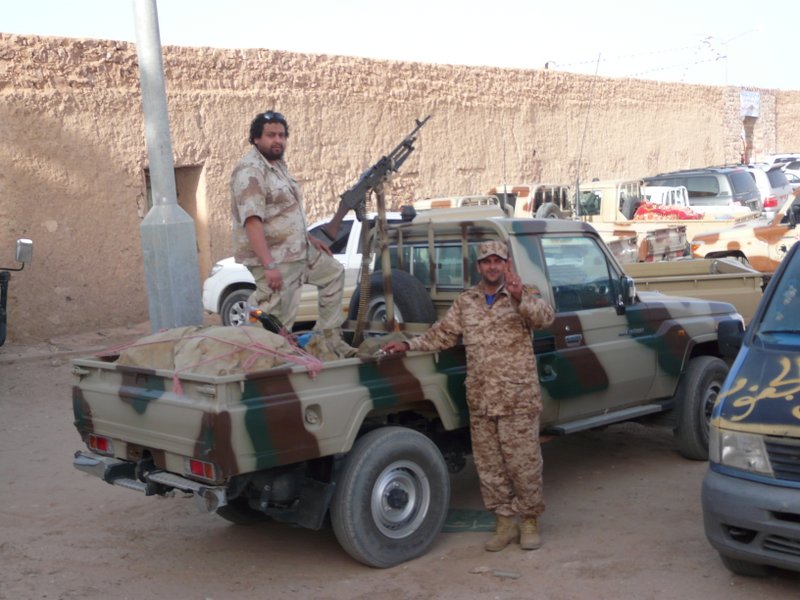
Soldiers from the Jebel Akhdar dispatched to Murzuk for the festival (Photo: Valerie Stocker)
Presenting a security update to the GNC two weeks ago, Yousef Mangoushnoted that the Border Security Force was being re-organised as it had been “established in a wrong manner”.
But the further south one drives the fewer non-locals can be seen. “Northerners are not suited to work in this climate”, said the Tebu guards. “Their units visit our outposts once in a while but usually stay close to Sebha where conditions are less challenging”.
Under Qaddafi, the Tebu were not allowed to join the armed forces or the police. These otherwise not very prestigious professions are now popular among Tebu youths. “I recently joined the army and am now stationed outside Obari”, said a young soldier from Murzuk proudly. Having dropped out of high school before the revolution, he again believes in his future and wants to be part of the new state.
But overall, the Tebu fighters are reluctant when it comes to relinquishing power and territory they acquired during the revolution and to give way to other national forces. In Kufra, they resisted against the Libya Shield Force that was sent down by the army to quell tribal violence, claiming that the brigade was siding with the Zway and pursuing its own political agenda. In Murzuk, the local border guards would rather receive better equipment from the government than reinforcement troops from up north, as the men at the military camp of Al-Wigh told a Libya Herald reporter back in January.
The Tebu fear renewed marginalisation and further infiltration – they say – by criminal gangs who seek to regain control of drug trafficking routes across south Libya. According to them, the power struggle is not only about border control though. Some believe that radical Islamist forces have devised a scheme to take control of the entire South and evict all Tebu from Libya by deploying brigades such as Libya Shield to strategic locations. They also claim the Islamists are the main beneficiaries of the drug trade.
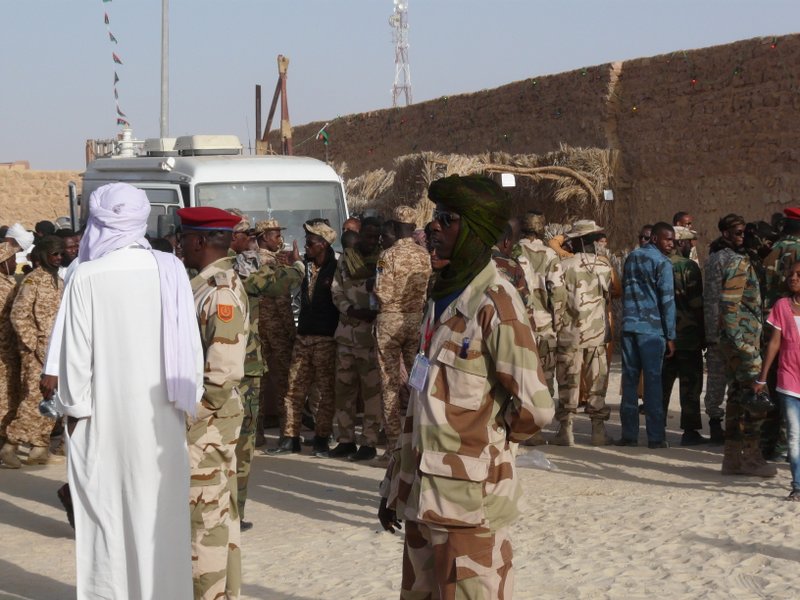
Security men watching over the festivities (Photo: Valerie Stocker)
These underlying tensions were not so evident at the Murzuk Festival, however. The local military council, which is headed by a Tebu, took precautions to ensure security. Brigades usually deployed elsewhere in the region, such as the Martyrs of Um Al-Aranib and Desert Shield, were controlling access roads into the town and made sure the celebrations went undisturbed. Due to the presence of high-level officials, the Chief of Staff had also sent additional forces.
Speaking the crowd, the governor of the militarised zone, Ramadan Al-Barasi, emphasised the importance of unity in the face of threats and expressed his conviction that the South can become a “stronghold of security”.
Hopefully more than wishful thinking, this recalled what one of the speakers had said earlier that day: “There will be no security and peace in South Libya without the sons of the desert”.
Share This Post


More from Libya Herald..
 Libya’s south: migrants’ journeys
By Beata Oleksy. Tripoli, 23 December: A migrants’ detention centre in Sebha was recently handed over to the Ministry of Interior by a local militia. According to Mohamed Madany, deputy head... The Libyan desert: natural and human heritage under threat
By Mustafa J. Salem, Geology Department, University of Tripoli. Tripoli, 19 April, 2013: Libya is a vast country that contains hundreds of major sites, representing various periods of histor... Ghat: a former Qaddafi stronghold struggles to keep up with Libyan revolution
By Houda Mzioudet. Ghat, 9 February 2013: The border town of Ghat, deep in Just south-west of the country is part of the historic province of Fezzan. Just outside the town lies the Algeri... Illegal immigration – a concern but “under control”
By Houda Mzioudet. Tripoli, 3 March 2013: "They may return, be jailed and so on and so forth; that is life. But otherwise there will be no illegal immigration." "They do not want to se... The other frontier warriors
By Beata Oleksy. Tripoli, 13 January 2013: The small military campsite overlooking desert routes from Chad, Niger and Sudan is hidden behind a rocky outcrop. For the past year this place has...- http://www.libyaherald.com/2013/04/08/defying-the-odds-the-first-national-tebu-festival-draws-libyans-from-across-the-southern-region-to-murzuk-despite-security-concerns/